Why My Agent Asks Before It Acts
Why My Agent Asks Before It Acts
Artemis is a smart-home agent. You speak to it, it decides which tool to call, and a relay clicks somewhere in the house. Building it changed how I think about agent design, and the change came from one realisation:
An agent that can write a bad paragraph and an agent that can switch on a heater are not the same category of system.
A bad paragraph is a retry. A heater switched on when nobody is home is a real consequence, and no amount of model quality reduces the probability to zero.
The loop
The core is the standard agentic cycle, and it is worth being precise about what "agentic" means here, because the word gets stretched:
- The user speaks or types.
- The model receives the request plus current context (time, sensor readings, device states) and selects a tool with arguments.
- The backend executes it against real hardware.
- The result is fed back as a function response.
- The model composes the confirmation the user hears.
Step four is the part people skip. Without it, the agent tells you it turned the fan on because it decided to, not because it did. When the relay fails, an agent without the feedback step reports success anyway. That is not a small bug in a system whose entire job is to act on the physical world.
The reasoning trace
Every tool in Artemis carries a parameter that has nothing to do with the tool's function:
"reasoning_trace": types.Schema(
    type=types.Type.STRING,
    description="A short continuous list detailing your observations and "
                "logical deductions that led to suggesting this action."
)
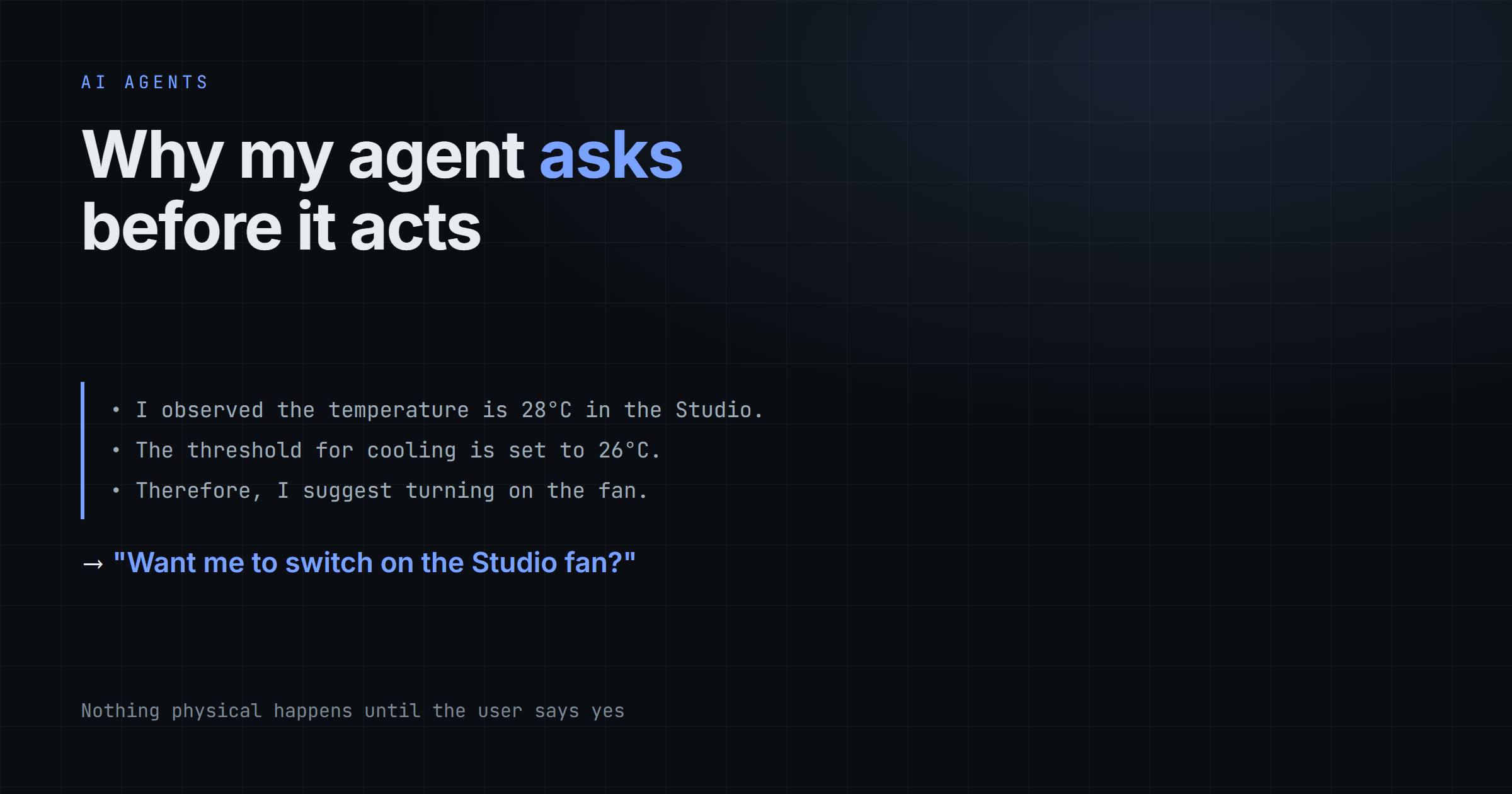
The model cannot call a tool without stating why. It produces something like:
• I observed the temperature is 28°C in the Studio.
• The threshold for cooling is set to 26°C.
• Therefore, I suggest turning on the fan.
Two things fall out of this, and only one was intentional.
The intended benefit is auditability. When the agent does something surprising, the trace is right there, and the bug is usually visible in it: the model read the wrong sensor, or applied a threshold from another room.
The unintended benefit was better decisions. Requiring the justification as part of the tool call appears to make the calls themselves more considered. I would not overclaim a mechanism here, but the effect was consistent enough that I kept it.
The approval gate
The system prompt requires that alongside any tool call, the model asks a short, plain question:
"Want me to switch off the Studio fan?"
Nothing physical happens until the user says yes.
This is the design decision people push back on, and the objection is fair: an assistant you have to confirm with is less magical than one that just acts. My answer is that the magic is not worth the failure mode. A false positive in a chat assistant is an awkward sentence. A false positive here is your lights going off during dinner, and the loss of trust from that is not recovered by the next ninety-nine correct actions.
The gate is also not universal. Automations the user has explicitly marked as not requiring approval run silently; the rule engine checks requires_approval on the automation itself rather than inferring intent from the action text. The user decides where the boundary sits. The system just refuses to decide for them by default.
The simulator, which is also a safety feature
Artemis has a Python simulator that reproduces the ESP32 firmware's exact REST and MQTT footprint. I built it so I could develop the backend without a wired breadboard on the desk.
It turned out to matter for testing behaviour, not just convenience. You can drive the simulator into states that are tedious or slow to produce physically (a temperature spike, a motion sensor firing at 3am, a device that stops responding) and check what the agent does. Testing an agent's judgment requires provoking the situations where judgment is needed, and physical hardware is a bad instrument for that.
Where this leads
Everything above generalises past smart homes. Any agent with real capability has real blast radius, and the questions are the same: can it explain itself, does it need permission, what happens when a tool fails, and can you reproduce the situation that made it misbehave.
That is the thinking I am carrying into Skyla, where agents run long tasks on a user's behalf. Sandboxed execution, no reach into the core backend, from the first commit rather than as a hardening pass later.
The interesting problem in agents is not making them capable. It is deciding what they are allowed to do with the capability.